
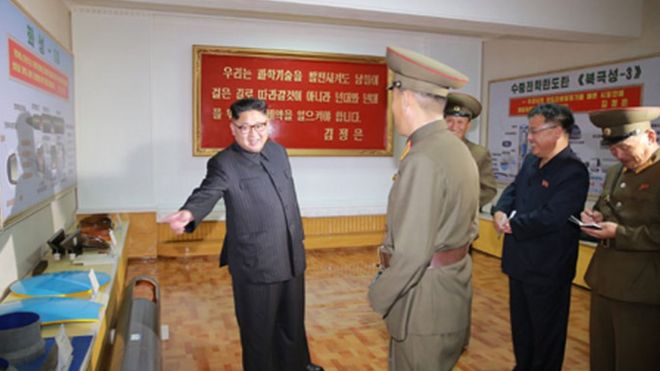
North Korea appears to have revealed details of two as-yet untested missile systems in its press coverage of a factory inspection by the country's Supreme Leader Kim Jong-un.
Photographs released by KCNA state news agency to go with a report on Mr Kim's visit to a facility at the Academy of Defence Sciences facility show wall charts describing the missiles, called Hwasong-13 and Pukguksong-3.
Hwasong-13 appears to be a three-stage ICBM (Inter Continental Ballistic Missile), while the chart showing Pukguksong-3, although largely obscured by officials, is an Submarine Launched Ballistic Missile (SLBM).
It's not the first time that North Korea has "accidentally" left details of important developments in the background of photo-shoots, and this is seen by analysts as a means of showing off its military power or sending messages to its foes.
Timed to warn America
North Korea's report of the visit appears to be deliberately timed, coming on the third day of the Ulchi Freedom Guardian military exercises involving South Korea and the United States, to which Pyongyang is vehemently opposed.
The timing and the content is critical. Speaking to South Korea's JoongAng Ilbo newspaper, Shin Jong-woo of the Korea Defence and Security Forum said that North Korea "has a history of displaying actual weapons, or graphic designs of them, via state media in order to flaunt its military prowess to the world."
According to KCNA, Kim Jong-un is said to have ordered scientists at the facility to produce more solid rocket fuel and warhead tips missiles, and these fit with the details displayed on the wall charts.
Unlike the liquid-fuelled Hwasong-14 missile which North Korea tested in July, Hwasong-13 appears to be a three-stage solid fuel rocket; while the solid-fuelled Pukguksong-3 is a longer-range version of the Pukguksong-1 and -2 missiles which were tested in 2016. Image caption The aerial view of Andersen Air Force Base is intended to send a message to Washington
Background details
Whether by mistake or as a ruse, it has happened before.
Two weeks ago, photos of Kim Jong-un planning a ballistic missile test in the direction of US Andersen Air Force Base on Guam also contained strategically-placed wall charts and and an ominous aerial view of the base itself.
The message here is clear. Pyongyang is telling Washington that American military power in the region is in their sights.
But it could all have been an "elaborate bluff," Seoul's Chosun Ilbo newspaper says.
The paper says that the aerial photo of the Guam base is six years old and publicly available on the Google Earth mapping service. North Korea has no facilities of its own to obtain satellite imagery.
Striking the US mainland
Pyongyang has used this intimidating tactic at a time of heightened tensions before - such is the cyclical nature of North Korean crises.
Kim Jong-un was photographed in March 2013 in a meeting with notepad-wielding generals after the region appeared on the brink of war following a North Korean nuclear test the previous month.
One of the charts, placed at a convenient angle for the camera, is titled "Plan to strike the US mainland", with one of the missile plots terminating in Austin, Texas. Image caption One of Kim Jong-un's senior officers stand in front of a chart saying "Plan to strike US mainland"
As an intimidation tactic though, the plan fell through - news of this threat was mostly met with mockery by Texan Twitter users, Washington Post reported at the time.
And as North Korea almost certainly did not have the technical capabilities to carry out such a strike, it would have been hard for it to carry the scheme through to completion even if it wanted to.
What Pyongyang doesn't show
While accidentally- or purposely-placed maps and charts give North Korea-watchers clues to the messages that North Korea is trying to send to the outside world, it's what Pyongyang doesn't show in its news reporting that can be just as revealing.
The omission of MiG-29 fighter jets from coverage this year's Air Force flight competition in June, an annual event given prominence due to Kim Jong-un's presence, could show that UN sanctions are biting hard at least in some parts of the country's military.
It's thought that parts and fuel for the country's most advanced jets are in short supply, and their disappearance from TV screens - which usually glory in the "invincible" strength of the armed forces - could mean that they are grounded, at least temporarily.
Communication in all its forms is tightly controlled by the government in Pyongyang, but sometimes the mask slips sufficiently to tell the world more than intended.
Tillerson said talks with the nuclear-armed North over its banned weapons programmes might be possible “in the near future”. The comments are a marked contrast to the rhetoric of recent weeks, when Trump spoke of raining “fire and fury” on the North, and come as tensions have eased after Kim pulled back from a plan to send a salvo of missiles towards the US Pacific territory of Guam.
But Washington also imposed new sanctions on Chinese and Russian firms suspected of doing business with the North. ADVERTISING inRead invented by Teads Kim Jong Un and Donald Trump , meanwhile, revealed significant technological advances in its missile programmes and ambitious plans to further improve its capabilities.
On a visit to the Chemical Material Institute of the Academy of Defence Science, Kim ordered stepped-up production of rocket engines and intercontinental ballistic missile (ICBM) nosecones, state media reported. At a campaign-style rally in Phoenix, Trump said his aggressive rhetoric was starting to bear fruit. “Some people said it was too strong.
It’s not strong enough,” he told thousands of supporters. “But Kim Jong-Un, I respect the fact that I believe he is starting to respect us. I respect that fact very much. “And maybe, probably not, but maybe something positive can come about.
” Earlier Tillerson acknowledged Pyongyang’s recent “restraint” in not carrying out fresh nuclear or missile tests in response to tough new United Nations sanctions, the seventh set imposed on it.
“I am pleased to see that the regime in Pyongyang has certainly demonstrated some level of restraint that we’ve not seen in the past,” Tillerson said at a rare press conference, adding that talks may be possible “in the near future”.
US officials told AFP that Tillerson was not thanking Pyongyang, nor making any concession on Washington’s determination to halt Kim’s missile programme and negotiate the denuclearisation of the Korean peninsula.
The Trump administration’s rhetoric has been highly variable but Washington has said it would be open to dialogue if Pyongyang took steps to calm tensions.
In a commentary earlier this week, the North’s official Korean Central News Agency described Trump as a “mad guy” who “frequently posts weird articles of his ego-driven thoughts in his twitter and spouts rubbish”.
Carbon compound Tensions between North Korea and the United States and its allies soared last month after Pyongyang tested two missiles that appeared to bring most of the US mainland within range. The North says it needs nuclear weapons to protect itself against the US it regards current joint military exercises by Seoul and Washington as a rehearsal for an invasion. It has made rapid technological strides under Kim, and released pictures Wednesday of a visit by him to the
Chemical Material Institute of the Academy of Defence Science, which develops the North’s missiles. Analysts said the images revealed major advances and ambitions. Kim, in a black suit, was shown next to a large brown tube that Joshua Pollack of the US Middlebury Institute of International Studies said on Twitter was a “wound fibre cylinder, evidently a large-diameter solid-rocket motor casing in the making”.
Such casings are harder to manufacture than metal ones but are much lighter, enabling longer ranges and heavier payloads. Other pictures included missile schematics and what appeared to be production processes. “We have diagrams and names on two apparent new solid fuel multistage North Korean nuclear capable missiles,”
one of them an Intercontinental Ballistic Missile and the other a medium- or intermediate-range device, said independent missile and nuclear analyst George Herbert. The official Korean Central News Agency said the nosecones and engine jets were made of “carbon/carbon compound material”, and that Kim “instructed the institute to produce more solid-fuel rocket engines and rocket warhead tips”. Many of the elements on show were objectives rather than currently existing technology, analysts said, but even so, Jeffrey Lewis, of the armscontrolwonk.com website, noted: “It’s all bad.”
“If I understand North Korean propaganda, this is their way of telling us what we’ll see in the air in the coming year.”
Trump has urged Beijing, North Korea’s only major ally, to bring greater pressure to bear in reining in its neighbour’s nuclear efforts, suggesting that the United States may offer concessions on trade in return.
On Tuesday the US Treasury slapped sanctions on 16 Chinese and Russian individuals and companies, accusing them of supporting North Korea’s weapons programmes and attempting to evade US sanctions. Beijing said Wednesday the move “will not help the solution of the problem”, nor would it enhance mutual trust.


0 comments:
Post a Comment